

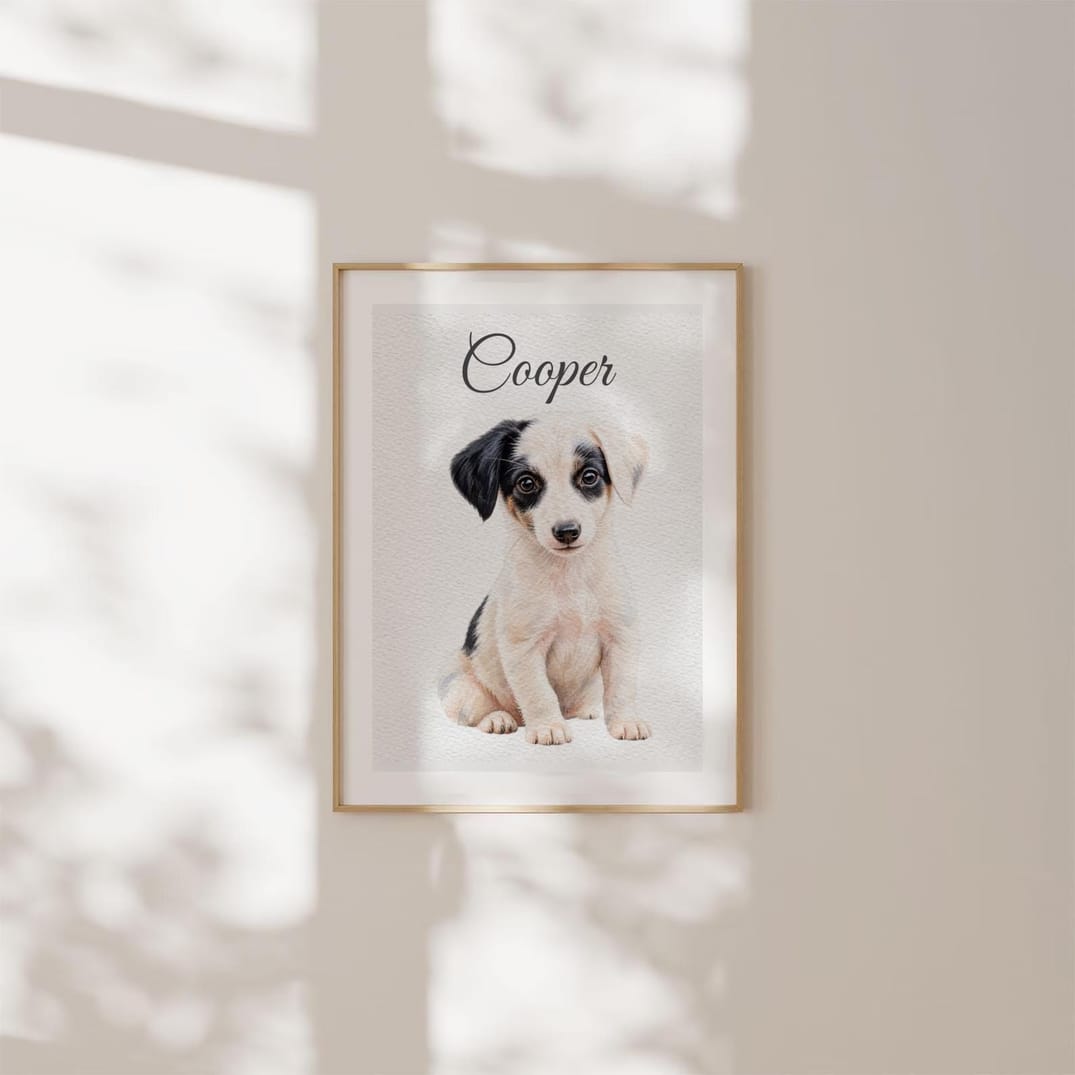
Choosing between a line art vs watercolor portrait is usually the last thing standing between you and a finished gift. Both styles begin with the same photo, both can look lovely on a wall, and both can go slightly wrong if the style ends up fighting the photo, the room or the person receiving it. This is the conversation I would rather have with you before any drawing starts.
Line art vs watercolor portrait: the quick answer
Choose line art if you want something calm and graphic that reads clearly from across the room, suits smaller frames and forgives an imperfect photo. Choose watercolour if coat colour, markings and eye colour are the whole point, if your photo is bright and reasonably sharp, and if the piece will hang at 8x10 inches or larger.
If both of those sound half right, skip to the sections on the room and on the recipient. Nine times out of ten the wall or the person decides faster than any comparison of the two styles.
What line art does well
Line art is a drawing reduced to its decisions. An outline, the weight of each line, and a handful of interior marks for the eyes, the muzzle and the fall of fur. Because so much is left out, what stays has to be right, and when it is right the likeness lands immediately.
It also behaves well as an object. A single-colour drawing sits happily in a thin black or oak frame, holds its own beside photographs, and does not argue with a patterned wall or a crowded shelf. On a gallery wall it works as a rest for the eye rather than another thing competing for attention.
Practically, it is the flexible option. The same file looks right at postcard size on a desk and at A3 above a sideboard, and it survives being printed on ordinary matte paper at a high street print shop. A pet line art portrait starts at $20 and arrives as a high resolution digital file, usually within one to two days.
Where line art needs care
Colour is the obvious loss. A ginger cat and a grey cat can end up looking like siblings, so if the first thing someone says about their dog is that he is an incredible red colour, line art is working against you from the start.
Strong markings need a decision too. A patched face, a brindle coat or a white blaze can be suggested with minimal shading or one accent tone, but it will be a hint rather than a copy. Tell me which feature matters most and the drawing can spend its detail there.
What a watercolour portrait does well
Watercolour carries everything line art leaves behind. Coat colour, the amber ring round an eye, the soft edge where fur meets nothing. Tortoiseshells, merles, brindles and anything ginger look like themselves in watercolour in a way they rarely do in line alone.
It also reads as affection. Soft edges and pooled colour feel handmade and gentle, which is why watercolour suits memorial pieces, new baby portraits and anniversary gifts. People tend to call line art clever and watercolour lovely. Both are compliments, just for different jobs.
Where watercolour needs care
It asks more of the photograph. Colour and shadow can only be as good as the light in the original, so a dim kitchen snap tends to go muddy, and a blurred muzzle stays soft because there is nothing underneath to define.
It asks more of the wall as well. A painted portrait has visual weight and wants a little quiet space around it, plus a generous mount if you are framing. Printed small it loses the very detail you chose it for, so treat 8x10 inches as a sensible floor and go bigger if the wall allows.
Let the room and the print size choose for you
Before you settle on a style, decide where it will hang. Stand in that spot and look at the wall colour, the frames already nearby, and how much daylight reaches the wall after four in the afternoon. That usually answers the style question better than any list of pros and cons.
Dark walls and dim hallways flatten watercolour. A monochrome drawing with a white mount lifts straight off deep green or navy paint. A bright, bare living room wall can take colour comfortably and often looks unfinished without it.
Size follows the same logic. Below 8x10 inches, choose line. At A4, 11x14 or larger, either style works and watercolour begins to earn its space. Check the frame you already own before ordering rather than afterwards, because an awkward size is the main reason a good file ends up in a drawer.
Let the recipient choose for you
If you are still torn, stop looking at the photo and think about the person. This is a gift, so it should sound like them rather than like your own taste. A few patterns come up again and again.
- White walls, wood, plants and a few framed photographs: line art, almost always.
- Patterned cushions, colour everywhere and a full gallery wall: watercolour will feel at home.
- Only one usable photo, and it is an old phone snap: line art will forgive far more.
- Two or three pets who need to appear together on one sheet: line art keeps the group readable.
- A memorial gift for someone still very raw: watercolour tends to feel warmer and more consoling.
- A student, or someone in a first flat: line art at a small size, easy to post and easy to frame.
- Grandparents, who usually want to see the actual colour of the dog: watercolour.
- Someone who never gets round to framing anything: choose a standard size and give it framed.
None of this is a rule. It is just the quickest way to stop going round in circles when you have two good options and one afternoon to decide.
What happens to a difficult photo in each style
Most photos are a bit difficult, and that is normal. The useful question is what each style does with the difficulty.
In line art, a cluttered background simply disappears, because the background is never drawn. Mild blur is survivable, since edges are being interpreted rather than copied. An awkward angle from above can be quietly improved, because simplifying a shape gives room to correct it.
In watercolour, a cluttered background can be softened or replaced, but poor light remains a problem, as the colour has to come from somewhere. Heavy shadow across one half of a face, a screenshot from a video, or a photo taken through glass will all limit how much likeness is possible.
Either way, the best thing you can do is send a better photo, and it is easier than most people expect. Our guide to choosing the best photo for a custom pet portrait covers eye level, window light and why the third photo you take is nearly always better than the first.
The other ways a photo or a date becomes art
A portrait is not the only keepsake, and sometimes the story is not a face. A custom map of the street where two people met, the village where they married or the town of a first flat can hold a memory that no portrait quite reaches. Maps also solve the problem of having no decent photograph at all.
Letter and song lyric prints work in a similar way. A few lines from a vow, a first dance, or a message written by a parent, set as clean typography, become something that can be framed and lived with. You will find portraits, maps and lyric prints together in the OpenHeartLines custom art shop.
For weddings and graduations, printable typography does the work on the day and stays useful afterwards. Guestbook signs, welcome signs and advice signs can be printed at home or at a local shop. If you are planning the day itself, our advice sign ideas for graduations and weddings pairs well with the instant downloads in the printable wedding and graduation signs shop.
How to decide in five minutes
Open the photo on a proper screen rather than a phone. If you can see the eyes clearly and the colour looks true to life, watercolour is available to you. If the photo is dark, soft or shot from an odd angle, line art is the kinder choice.
Then measure the frame, or the gap on the wall, and write the size down. Small means line. Large and bright means either. Finally, picture the piece in the recipient's hallway and ask whether it looks like something they chose themselves.
Whichever you pick, personalised work is prepared within one to two days and delivered as a high resolution digital file, so there is time to print, mount and wrap it properly.
Frequently asked questions
Which is better for a pet portrait, line art or watercolour?
Neither is better, they suit different pets and different homes. Line art is stronger for simple coats, small frames, imperfect photos and groups of pets. Watercolour is stronger when coat colour and markings are the reason you love the animal, and when the photo has good natural light and a sharp face.
Can I have the same photo done in both styles?
Yes, and people often do it for two different rooms or two family members. Just ask when you order so both pieces can be planned from the same photo and cropped to match. Each style is priced and prepared separately, and both arrive as high resolution digital files ready to print.
What size should I print a watercolour portrait?
Treat 8x10 inches as the smallest size worth printing, and A4 or 11x14 as the comfortable range for a living room wall. Anything smaller loses the soft colour transitions that make watercolour worth choosing. Buy the frame before you print, then print to that exact size rather than trimming afterwards.
What if my only photo is blurry or badly lit?
Send it anyway and ask before ordering, because a quick look will tell you whether it can carry a portrait. Blurry or dim photos usually work better as line art, where edges are interpreted rather than copied. If the pet is still with you, one new photo by a window solves most problems in a minute.