

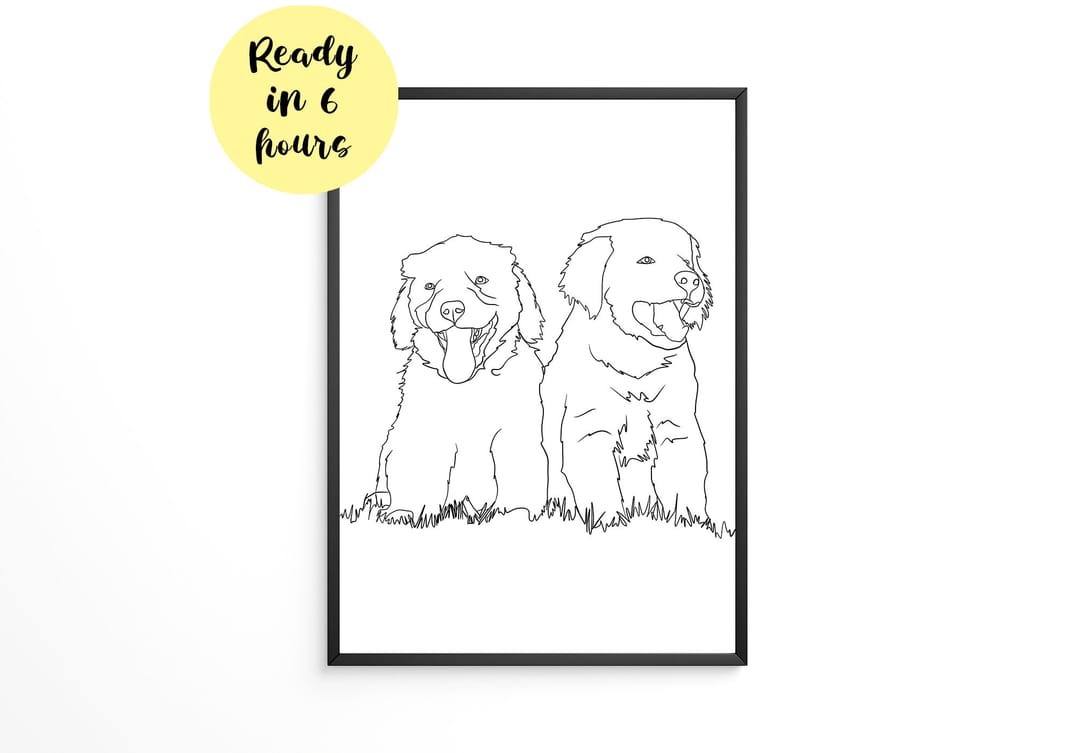
Every custom portrait begins with a photograph, and that photograph quietly decides most of what the finished piece can be. If you are wondering what the best photo for a custom pet portrait looks like, the honest answer is that it is rarely the prettiest picture on your phone. It is usually the clearest one, taken in good light, at the same height as your pet's eyes.
Quick answer: send a sharp, well lit photo taken at your pet's eye level, close enough that the face fills a good part of the frame, with the eyes in focus and the original file unedited. Daylight near a window or outdoor shade beats a camera flash every time. If you have three or four options, send them all and let us choose.
What makes the best photo for a custom pet portrait
A portrait is a record of small details: the set of the ears, the line where the fur changes colour, the exact shape of the eyes. All of that has to be visible in the photograph before it can be drawn. When a picture is dark, soft or taken from above, those details are not hidden so much as missing, and no amount of drawing skill invents them accurately.
Three things matter far more than anything else, and they are all free to fix. Light, angle and file size. Get those right and almost any phone from the last several years will give us plenty to work with.
Light does most of the work
Natural, soft daylight is the ideal. Sit your pet a metre or two from a window on a bright but overcast day, or step outside into open shade such as a porch or the shadow of a building. You want light that wraps gently around the face rather than punching in from one side.
Avoid direct midday sun, which turns pale fur into a white blur and dark fur into a shapeless patch. Avoid flash too. Flash flattens the face, blows out whiskers and gives that green or blue eye shine that hides the real eye colour completely. For black dogs and black cats, soft daylight is not a preference, it is the only way to see any structure in the coat at all.
Shoot at your pet's eye level
Most photos of pets are taken from a standing human's height, looking down. It is how we see them all day, so it feels natural, and it is also the single most common reason a photo will not work well for a portrait. From above, the muzzle shortens, the head looks oversized and the chest disappears.
Kneel, sit or lie down so the camera is level with your pet's eyes. Then move closer than feels necessary. A portrait crops in tightly on the head and shoulders, so a full body shot taken from across the room leaves us with a face only a few hundred pixels wide. Close, level and patient is the whole technique.
Send the original file, not a screenshot
Screenshots, pictures downloaded from social media and images forwarded through messaging apps are all compressed, often heavily. They can look fine on a phone and fall apart the moment they are enlarged. Send the original photo straight from your camera roll or cloud album so the full resolution survives the trip.
If the file is too large to attach, that is a good sign rather than a problem. Use a link to a cloud folder and we will download it at full size.
A checklist before you send your photo
Run through this quickly before you place your order. It takes a minute and it saves messages back and forth later.
- The eyes are sharp and in focus, and you can see their real colour.
- The photo was taken at your pet's eye level, not from above.
- The head and shoulders fill a decent portion of the frame.
- The light is soft daylight, with no flash and no harsh shadow across the face.
- Both ears are visible, and the whole head is inside the frame.
- Nothing important is hidden by a hand, a lead, a blanket or a toy.
- You are sending the original file, not a screenshot or a social media download.
- If the collar, bandana or harness matters to you, it is clearly visible.
If a photo fails one point but wins on character, send it anyway with a note. A slightly imperfect picture of the expression you love is often a better starting point than a technically clean photo that looks like someone else's dog.
Photos for a pet memorial gift
Memorial portraits come with a different set of rules, because you are working with whatever photographs exist. There is no retaking the shot, and that changes what we ask for and how we work.
Send more than one image. Three or four pictures of the same pet, even imperfect ones, let us cross reference the shape of the head, the markings and the eyes. One photo might be blurry but show the right expression, while another is sharp but taken from an odd angle. Together they tell us far more than either alone. A short note helps too: tell us what made that face distinctive, whether one ear sat lower, whether the white patch on the chest was larger than it looks in the photo.
When the only photo is soft or low resolution
Old phone photos, printed pictures rephotographed on a table, faded snapshots from years ago: all of these can still become a portrait, particularly a line art or watercolour pet portrait from OpenHeartLines, because both styles interpret rather than reproduce. Line art in particular is forgiving, since it reduces the face to considered strokes rather than exact pixels.
What cannot be recovered is information that was never in the photo. If the eyes are a soft grey smudge, we will draw a careful, sympathetic eye, but it is an informed reconstruction. Say so up front if that matters to you and we will talk it through before starting.
Small details worth mentioning
For a memorial piece, the details people miss most are often the ones a photo shows badly. A favourite red collar that looks brown in low light. A name tag. The grey that came in around the muzzle in the last year or two. Tell us which version of your pet you want remembered, because we can adjust colours and soften or keep the grey as you prefer.
How to send a group photo of several pets
Getting two dogs and a cat to sit still together is a rare event, and you do not need to attempt it. For a multi pet portrait, the best approach is usually one good individual photo of each animal, taken as close to the same light and angle as you can manage. We then arrange them into a single composition.
If you are sending separate photos, include a line about relative sizes. Photographs taken at different distances remove all sense of scale, and a small terrier can easily end up drawn as large as a labrador unless you tell us the terrier stands about knee height. A simple sentence such as "the ginger cat is roughly half the height of the spaniel" is enough.
Do also say how you would like them arranged, if you have a preference. Side by side in a row suits a long print above a sideboard. A stacked or overlapping arrangement suits a square frame. If you are not sure, tell us where the print will hang and we will suggest a shape that fits the wall.
Choosing a style once your photo is sorted
Once you have the photograph, the next decision is the style, and the two suit different pictures. Fine line art leans on shape, expression and the clean edge of a silhouette. Watercolour leans on coat colour, softness and warmth. A photo with unusual markings or a distinctive coat colour often rewards watercolour, while a strong profile or a striking pair of ears can be perfect in line.
If you are weighing it up, our guide to choosing between line art and watercolour portrait styles walks through how each one handles fur, background and framing. Pet line art starts at $20, which makes it an easy first commission if you want to see how your photo translates before ordering something larger.
What actually happens after you order
Once your order is placed, you send the photo or photos through Etsy messages, along with any notes about colours, names or arrangement. We look at the images first and come back to you if anything needs clarifying, such as a face that is cropped at the edge or a photo that is too small to use. This is the point where a second option saves time, so send spares if you have them.
Most orders are drawn and delivered as a high resolution digital file within one to two days. You receive a file sized for printing, not a small web image, so it can be printed at a photo lab, sent to a framer or run off at home. Small adjustments after delivery are normal and expected: a colour that needs warming, a collar in the wrong shade, an ear that wants lifting slightly.
Because the file is yours, you can print it once now and again later at a different size. If you are printing at home, our notes on printing digital art at home cover paper weight, borders and getting colours close to what you see on screen. And if the portrait is a gift, a digital file means nothing has to arrive in the post at the last minute.
Frequently asked questions
Can you work from a blurry or very old photo?
Often yes, especially for line art, which interprets the face rather than copying every pixel. Send two or three images of the same pet so we can compare details across them. If the eyes or markings are genuinely unreadable, we will tell you before starting and suggest the style that handles the softness most gracefully.
Does the background of my photo matter?
Not much. Backgrounds are removed or replaced as part of the work, so a cluttered kitchen or a messy garden is fine. What matters is that your pet's outline is distinguishable from what is behind them. A black cat photographed against a black sofa is the one case where a different background genuinely helps.
How many pets can go in one portrait?
Two, three or more works well, and they do not need to be photographed together. Send one clear photo of each animal, taken in similar light where possible, plus a note on their relative sizes. Tell us the shape of print you want and we will arrange them to suit the frame and the wall.
What size can I print the finished portrait?
The delivered file is high resolution, so standard frame sizes are comfortable, and larger prints are usually fine too. The limit is set by your original photo rather than by us, so a sharp, close, well lit picture gives you the most flexibility. Ask before ordering if you have a specific large size in mind.